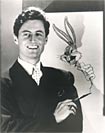
The Masters Of Warner Bros. Animation worked in a run-down back lot building known as ‘Termite Terrace’.
Warner Bros. emerged by the 1940’s as the dominant studio in animated short subjects, a result of the extraordinary talent of the directors, animators, voice talents, writers and musical direction of their production units.
Bob Clampett (1913-1984) was one of the pioneers of American Animation. In his teens, Clampett designed the first Mickey Mouse doll for Walt Disney. Shortly thereafter, Clampett went to work at the Harman-Ising studio and animated scenes for the first Merrie Melodie made, “Lady Play Your Mandolin.” In 1935, when the studio was still looking for a star, Producer Leon Schlesinger suggested a cartoon version of Our Gang. Taking the reins, Clampett designed a fat little pig named Porky and a black cat named Beans for Friz Freleng’s cartoon “I Haven’t Got a Hat”. Although Beans got top billing, Porky was a hit, and subsequently became Warner Bros. first cartoon star.
That same year, Clampett became an animator and key gagman for new director Tex Avery. Their work space was called Termite Terrace, which was named because of the termites that could be heard chewing the building’s woodwork. Avery and Clampett’s collaboration
created a wild and irreverent style of animation never before seen in animation. Soon, this type of animation came to be known as “the Warner style.” Under the guise of this style, Avery and Clampett developed Daffy Duck in his premier cartoon “Porky’s Duck Hunt”. Bob animated
the infamous scene of Daffy woo-wooing his way across the lake. But it would be later that both men contributed to the creation of Warner Bros. biggest star, Bugs Bunny.
In 1937, Clampett was promoted to Director, and would, for the next nine years, direct some of the funniest and wildest cartoons ever produced. Utilizing extremely well-developed personalities and developed story lines, Clampett gave the cartoon community classics such as “Porky In Wackyland,” (1938), “Corny Concerto,” “Coal Black and De Sebben Dwarfs. (1943), and “The Great Piggy Bank Robbery” (1946). Clampett also introduced new characters to the Warner Bros. stable, including Beaky Buzzard from “Bugs Gets the Boid,” and Tweety, whose first appearance was in “Tale of Two Kitties.”
Clampett left Warner Bros. in 1946 to open his own studio. He created a live daily puppet show, featuring a sea serpent named Cecil, and the serpent’s propeller-and-hat-topped pal, Beany. “Time for Beany” earned Clampett three Emmy awards for best Children’s program. In 1961, Beany and Cecil debuted on ABC with their own animated show, which ran five years straight on the network. The show was produced by Bob’s wife Sody, who continues to run his business today. Sketches from their home were used to create backgrounds for episodes, and Bob’s son Bob Jr. and daughter Ruth did voices for the series, truly making it a family affair. “Beany and Cecil” can still be seen worldwide to this day.
During the last part of his life, Bob lectured at colleges on the history of animation and made appearances at museum events and conventions. In addition to pioneering many filmmaking techniques that are used in current animation, Clampett remains a real animation fan’s director. To say the least, Clampett’s animation has secured him a place as one of the most recognizable and legendary animator/directors in the cartoon genre.